

Note: Everything I have written here is the fruit of many years of study and repeated readings of Eugene Gendlin’s book AProcess Model. However, the text reflects my own learning and understanding. It does not necessarily express additional layers in Gendlin’s writing. It is meant to make complex and innovative ideas more accessible and to support understanding. Nonetheless, it is not a substitute for reading the original—Gendlin’s book.
Sequences in the life process are not necessarily linear.
I am sitting in front of the computer, intending to write the current post. I still have no idea how to begin. Yet, as I'm sitting in front of the computer, situations and actions are implied. For example: I start writing something general… writing an example… or another example… rereading Chapter 2 of A Process Model… going over things I once wrote for some inspiration… wandering through the web and Facebook… eating something… going outside for a walk…
All of these are possibilities implied in the situation. None of them are happening yet. I am still sitting in front of the computer with an intention…
Eventually I get up from the chair and go make myself another cup of tea. This is what actually occurs, although it may not have been one of the possibilities I considered.
Then, while making the tea, an idea for opening the post emerges.
And now… every sentence that is written (occurring) holds within it / hints at / gives rise to (implies) various possibilities for the next sentence that is about to be written. When the next sentence is written (occurring), it, again, holds within it / hints at / gives rise to new possibilities for the next sentence… and so on.
Explicating the Experience of Time
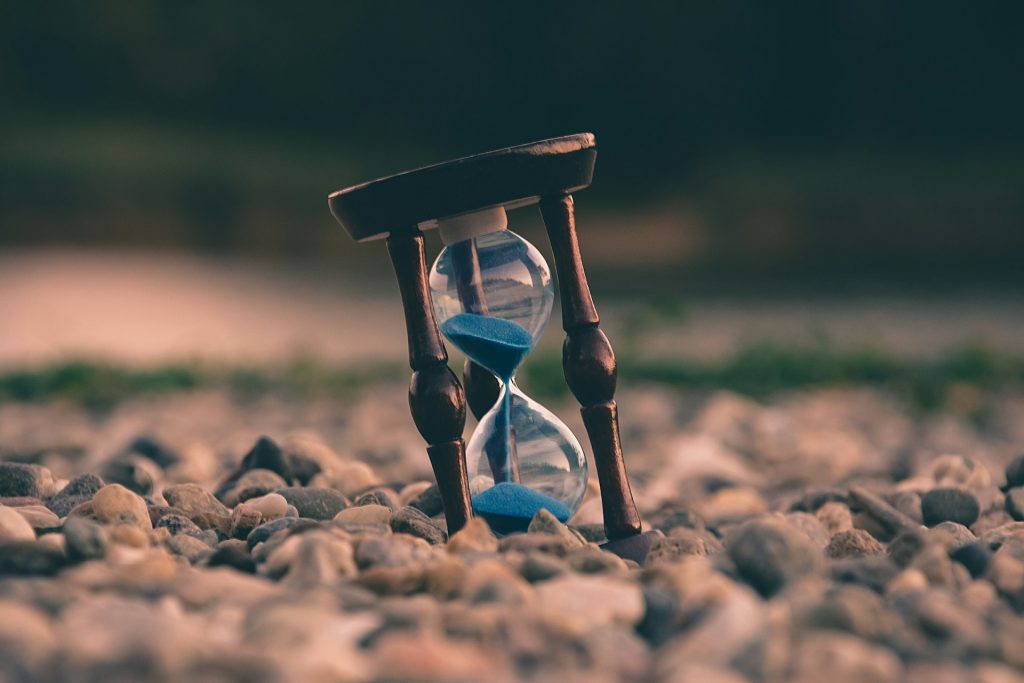
The initial writing of the first part of the post took me 17 minutes. How do I know? Because I looked at the clock. Time of the process of thinking and writing is measured by the process of counting the seconds and minutes on a clock. The counting process of the clock is agreed upon by everyone as a universal process of measuring time. The assumption of the prevailing model is that time is linear and can be measured by a fixed external measure such as a clock, an hourglass, a pendulum, and so on.
But Gendlin, in creating a new model, asks us to let go of this assumption. The experience of time can be formulated and conceptualized in a variety of ways, not only through the linear time model. Gendlin suggests that the life process itself can generate its own time in the new model. Later we will see how we arrived at the linear time of the clock, but we will not assume in advance that time = clock time, because there are many ways to formulate time.
Although we use linear time since it is inherent in our language and experience, other kinds of time are inherent in them as well, perhaps kinds of time that have never been explicated before.
(A Process Model, p. 9)
Occurring into Implying
The concept of implying develops throughout the book. It gains additional meanings from Chapter 1 to 2. In Chapter 1, the body and the environment implied each other. In Chapter 2, the meaning of the concept expands: implying generates time (as we will see in detail later). Every occurring is also an implying of further occurrences.
In all areas of life, we can notice implying in life processes: thirst seeks hydration, hunger strives for satiety, pain seeks relief, fatigue aims for rest, boredom seeks interest, curiosity seeks discovery, and so on.

These pairs are not simply placed one after the other, like stones along a path or discrete events on a timeline. They are bound to one another in a relationship of implying and occurring: when we are thirsty, we strive / want / expect our thirst to be quenched. Thirst and quenching are bound together by thick strands of meaning. When we are thirsty, drinking is meaningful to us. When we are tired, we long for rest. In boredom, our body strives for something that has interest.
An Exercise
Take a breath. Notice that the exhalation occurs after the inhalation, and this repeats. An observer can notice the inhalation and exhalation "placed" one after the other.
Now take a breath, followed by an exhalation. Then, stop the breath when you are without air. Notice what happens to you. Feel your implying to inhale again. Let the air fill your lungs. The inhalation is not simply “placed” after the exhalation. It arises from it; it is bound up with it.
One more important point about the relationship between implying and occurring in the life process. What is the relationship between hunger (implying) and a sandwich (occurring)? The sandwich (occurring) is not identical to what was implied. The sandwich that satisfied my hunger is not identical to “what the hunger wanted.” Hunger is a rich and broad experience that seeks (…). There are many possibilities for becoming satisfied. The sandwich is only one specific possibility, and it appeared into the implying.
Implying and Occurring in an Ongoing Life Process
I finish writing the post.
I do not place a word after a word “just like that,” randomly. A word gives rise to the next word. A sentence gives rise to the next sentence. When I wrote a sentence, it occurred, that was an occurring. Immediately from it a new implying emerged. It emerged with a sense of continuation, a meaning of what needs to come next. Into this sense of implying a new sentence appears, and so on.
The same pattern happens in every sequence in the process of life.



I'd love to read what you thought: