

Note: Everything I have written here is the fruit of many years of study and repeated readings of Eugene Gendlin’s book A Process Model. However, the text reflects my own learning and understanding. It does not necessarily express additional layers in Gendlin’s writing. It is meant to make complex and innovative ideas more accessible and to support understanding. Nonetheless, it is not a substitute for reading the original—Gendlin’s book.
The model Gendlin develops in his book A Process Model is unique, as I mentioned in the introduction. One of the unique aspects of this model is its paradigm shift. It causes us to look at the world in a new way that we are not accustomed to, but one that is highly powerful for understanding life processes. It challenges our conventional thinking in the sense that its basic ideas are "more than logical." Our ordinary logic fails to grasp them. At the same time, the concepts and ideas remain consistent all along the way with this way of thinking.
This section is a reflective interlude that looks at the unique way the model was created and its characteristics.
Gendlin notes that one can skip this section on the model's characteristics and return to it later if desired. Skipping this part does not disrupt the sequential development of the model. Nevertheless, in my view, this is one of the most important sections, and it deserves time and attention. Gendlin's unique way of thinking and the assumptions underlying the development of the model receive a clear examination here.
Gendlin refers to 6 unique characteristics:
- Interaction First
- A Different Model of Time
- Process Events
- Non-Laplacian Sequence (Non-causal sequence)
- Many Making One (Multiple factors shaping a single event)
- Units emerge, and can re-emerge differently
Here is an overview of each characteristic:
1. Interaction First
The concepts in the model stem from the intention to place interaction first (Interaction First). Already in Chapter 1, we were introduced to the idea that the body and the environment are a single event. First comes the interaction between the body and the environment, and only then can we speak of body and environment as separate, in a limited way.
We experience many interactions in our lives, and they can serve as excellent examples of the concept: Interaction First.
Have you ever noticed that there are people around whom you feel yourself at your best? In their presence, you feel charming, relaxed, smart, and sharp. On the other hand, are there people around whom you feel insecure, weak, and unimpressive?
Interactions between people are deeply interesting. If you pay attention and check inside, you will discover that your identity can be entirely different with different people. Why does this happen?
The ordinary way we explain interaction is through a one-way influence that causes a reaction in the second direction, which in turn causes another influence in the first direction, and so on:
For example, two people in a close relationship might find the following pattern: "If she were just a little better or a little more loving, then I could be so good. But I can't. Why not? Because she won't let me. She isn't even a little better. And why not? Because of how I am. If I were just a little better, then she could treat me the way I need to be treated, so that I could be a little better, so that she could." (Gendlin, 2018, p. 30)
In other words, according to the existing model, interaction stems from the way its components (for example, the people) act. First, the people exist and act, and they essentially create the interaction as it is. In the example above, when we meet a certain person, the way they treat us makes us feel insecure, weak, and unimpressive… and then, our feeling causes us to act insecurely, which in response gives them a sense of superiority that amplifies their behavior toward us, and so forth. Thus, a specific interaction is formed, created by two people through the way they behave toward one another.
In this way of thinking, each individual takes turns influencing the other, and then the second influences the first, back and forth. Each person is considered a separate unit contributing their part to the interaction. This is a thinking pattern that brings us back to the schoolyard, where two children are fighting, and the teacher separates them and inquires: Who started it? Of course, this question is difficult to answer, because each child was reacting to the previous behavior of their peer, and so on.
The word "interaction" makes it sound as though there are first two separate entities, and only then do they interact. But in Gendlin’s model, the interaction is first, and the identity of its components is determined by the interaction.
How does Gendlin conceptualize interaction?
According to Gendlin, you and I happen together, and in doing so, we are immediately different from how we usually are. Each of us is the environment for the other.
How does this happen? Gendlin explains his logic:
"How you are when you affect me is already affected by me, but not by me as I usually am, but by me as I occur with you." (Gendlin, 2018, p. 31)
It is interesting to recognize the circularity of this phenomenon—who influences whom first? Do I influence you first, and then you influence me? Or do you influence me first, and then I influence you? There are no ordinary causal relationships here, nor does time operate in the usual way where one thing happens first, followed by another thing influenced by it. The influencers are influencing and being influenced in a simultaneous, mutual impact. Everyone within the interaction is already inherently influenced by the other from the start.
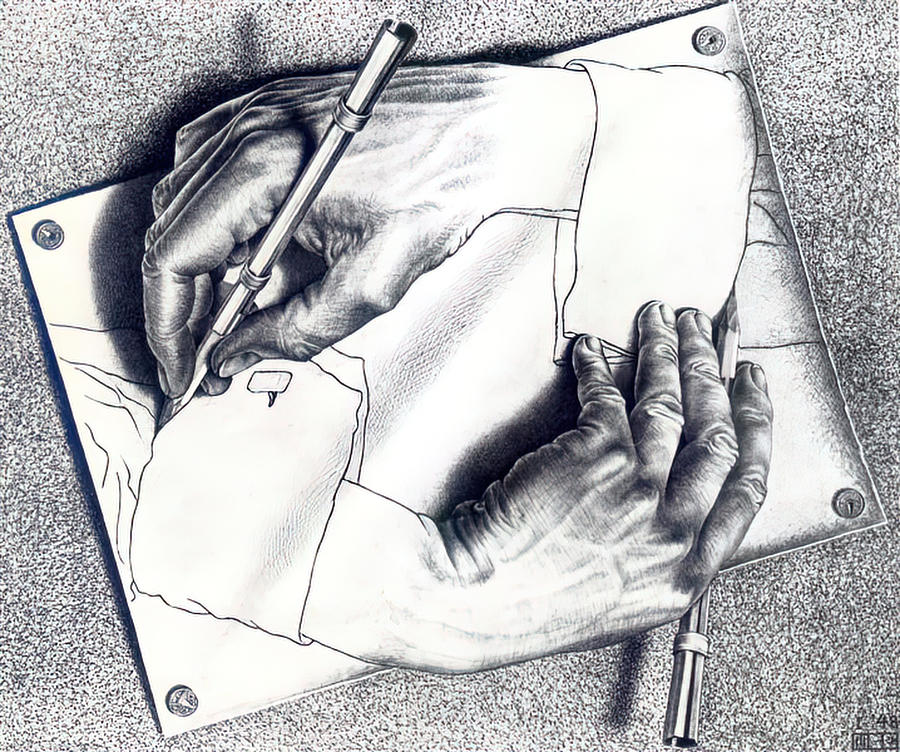
Hence the feeling of immediacy when two people meet—both transform into a unique identity determined within the interaction. One influences the other while simultaneously being influenced by her. But not by her as she was before the encounter, but by her as she has already been changed by him.
Look at any interaction in your life and try to feel the concept of "Interaction First." What do you discover?
This way of thinking about interaction first already hints at Gendlin’s concept of time, which is the next characteristic.
2. A Different Model of Time
Usually, we track cause and effect sequentially, one after the other:
- She influences me,
- then this causes me to behave in a certain way,
- then this behavior of mine influences her in that way, etc.
In Gendlin's model, both influence each other through "coordinately differentiated" and "original interaffecting" (see the post "Already Coordinated Processes"). Neither precedes the other in time.
When explaining something in the old model, it seems necessary to show that something was there before, at an earlier time, to account for it. The existing model denies that something new—which did not exist before—can happen. Instead of something simply happening, the existing model shows that it already existed and merely needed to be reorganized.
Gendlin proposes a new understanding of time in which we can explain something without needing to show that it was already there at an earlier time. In such a conceptualization, novelty can emerge because something simply happens, and it is genuinely new, rather than being the result of a reorganization of things that occurred previously.
3. Process Events
The third characteristic relates to the nature of process. Instead of speaking about structure and pattern, Gendlin proposes focusing on the process of structuring and patterning. His claim is that if we think of everything in terms of existing patterns, we will not be able to "jump" from one pattern to another. It is impossible to get from one structure to a structure that is built differently. Instead, Gendlin speaks of process nature—the arising and emerging of forms and structures.
For example, Jean Piaget’s theory of cognitive development demonstrates jumps from one developmental stage to another. While Piaget describes the patterns of children at each developmental stage in great detail, he fails to show and explain the jumps between the stages. He describes four levels of development: the sensorimotor stage, the preoperational stage, the concrete operational stage, and the formal operational stage. Each level is meticulously characterized with examples and explanations. However, he does not show how the child develops from one level of development to a higher one.
Gendlin's model describes the emergence of each stage out of the preceding developmental stage. This process-based development can be identified throughout the entire construction of the model.
4. Non-Causal and Non-Deterministic Sequence
If we look at our lives and our personal growth over time, we notice that it was impossible to predict the steps in advance. In every step we took along the way, there was novelty—a novelty that occurred when our aspiration met what reality presented to it.
According to Gendlin, the implying implies its own change. This change is new, fresh, and unknown in advance. It is not a consequence or a reorganization of what preceded it.
Gendlin positions his conceptualization against the scientific conceptualization that is radically expressed in the famous statement by Pierre-Simon Laplace. Laplace said:
"If I knew where all the particles of the universe were located at this moment, their velocity, and the direction in which they are moving, I could tell you the entire past of the universe and predict its entire future." This is an assumption embedded in the mathematical concepts used by the existing model. It is worth noting here that Gendlin recognizes the importance of mathematics and science, and appreciates their value greatly. He mentions in every opportunity that Mathematics and science have brought humanity to extraordinary achievements.
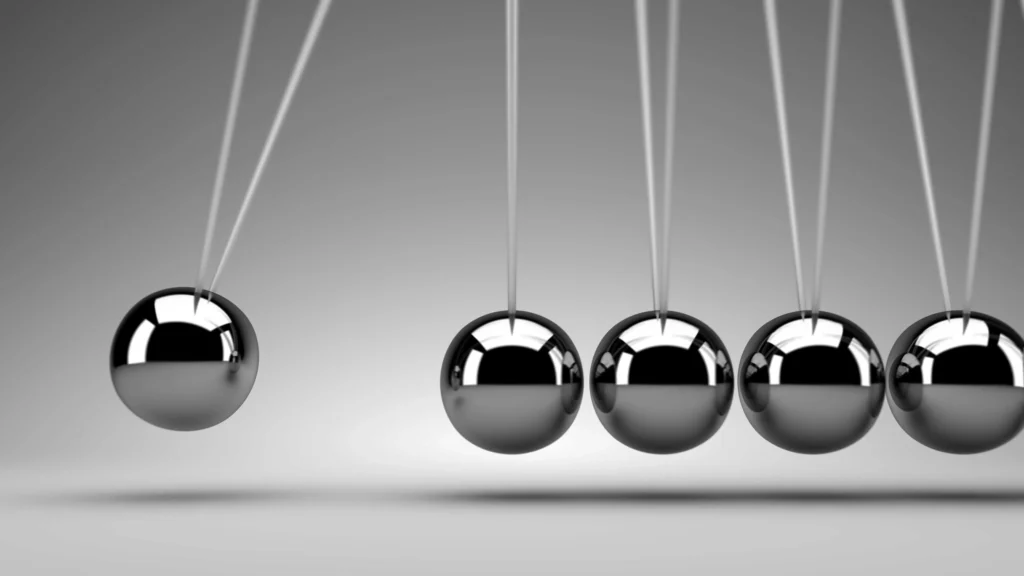
Gendlin argues that a model of life needs to account for something new happening—something new that cannot be found beforehand, but is generated right now. That is to say, Gendlin challenges mathematical causality where a cause leads to an effect. In the process of life, the next step is not determined by this kind of causality. Something happens, and a new step occurs that could not have been predicted in advance.
Our thinking is accustomed to the mathematical-logical model and explains everything that happens by pointing to something in the past that caused it. It is important to understand the underlying assumptions behind this thinking—Gendlin calls the existing and prevalent thinking model The Unit Model. The underlying assumptions behind this powerful model are:
- A. Everything is built from pre-existing units.
- B. When something is constructed, each of its parts (its units) is initially separate and independent, and is therefore perceived as capable of existing on its own.
- C. When a unit joins other units, it retains its identity exactly as it was before (when it was alone). A unit functions as itself—it is autonomous.
If something new can ever occur, then something new must presumably be occurring right now as well. Where is there room for something new to appear within the Unit Model?
Past-Present
If we extend Laplace’s way of thinking, we reach the conclusion that the future is determined by the present, and the past led to the occurrences of the present. Gendlin argues that past experiences do not determine present events on their own, but the past functions in some way, right now.
When I experience what is happening now, being present in the occurrence at this very moment, what happens to the past? Where is it located? Is the present only what it is, and the past is something else? Are they simply placed in different positions on a timeline?
Gendlin creates a new conceptualization of time out of the experience of the present and the experience of the past. The past functions implicitly within the present and participates in its creation.
Suppose I go for a hike on Mount Carmel. In my walking, many past experiences function: previous hikes on Mount Carmel, hikes in other places, conversations I had during prior walks, stopping to rest and enjoy the view, and so on… In fact, during the hike in the present, I do not experience those past experiences as they were. The past experiences function while I am fully in the present, creating a context and a rich present experience. One can also experience the past by reviving a memory or daydreaming, but then we miss out on the experience of the present. The past plays a role even when I am fully in the present. The experience of the past participates in creating the present.
5. Many Making One (Multiple factors shaping a single event)
Let us begin with an example: How does an insight arrive?
When you desperately want an insight to appear, it doesn't really work. It is not a logical process where you take certain steps that inevitably lead to an insight. An insight simply appears.
However, if we examine the appearance of an insight, we can notice how the past functions in its formation—the formation of a creative novelty in the present. Many past experiences and interactions function within the current experience. This is not the past as it was back then, but the past that participates now and is relived in the body right now. The past contains many events, but the present is only one, right now. Many experiences participate in a single event now. This "unseparable multiplicity" functions in the present and participates in a single, fresh creation.
Gendlin uses another example—the creation of a snide, funny remark. The idea is similar. The concept that emerges from the experiences of creating an insight or a funny remark is: "Many making one."
The many and the one mutually determine each other. The past that participates in the present right now shapes the present. The unseparable many are in interaction first, and only then can they be addressed one by one. The next implied single step is created from many aspects that formed it into a single fresh creation. This creation is not derived from a previous pattern or a set of units.
6. Units Emerge, and Can Re-emerge Differently

When we try to understand something or give meaning to something, we do not presuppose fixed units with which we think. The units are created anew in the process of meaning-making. They are created anew by how the whole is changed by the movement of thought. Gendlin's model does not assume a given set of units. Units are created from the interaction and from the process of meaning-making. They are created anew, both in terms of their number and in terms of what they are.
We are not supposed to replace nature and bodily life processes with fixed units and logic, even if using them is highly powerful. We would not want to think of nature as being artificially constructed of separate, fixed units. Humans create and use graph paper, but nothing in nature appears as uniform units. Every leaf and every cell is slightly different.
Instead of a fixed set of units, we need concepts to think with—concepts that explain how units emerge and can re-emerge differently.



I'd love to read what you thought: